Wednesday, June 5, 2013

How Presentations Move Clients to Action

When you are given the opportunity to make a client presentation, what is your action plan?  At this point you have completed the “go-no-go” process and are looking forward to winning new business. Don’t let your competition or ego get in the way. Frame your next presentation as a journey and you will win.  If you understand that humans are wired to listen to stories, are you telling a story during the presentation? Is the client listening?  Since your story and the stories of your firm are more involved than a 30-minute presentation, your biggest challenge will be deciding where to start and where to end.  You can lose the audience in a heartbeat when you assume they have more knowledge than you do or when you bury them in jargon.  Being yourself might be a cliché, but it begins with who you and your firm really are.

The owner of an engineering firm I consulted with a few years ago had received a heart transplant and from that started his own business.  What do you think was his story during client presentations?  His message was simple and his journey was clear.  He did a superb job of quickly introducing the value his firm brought to the important client issues while wrapping the journey in his ability to overcome obstacles.  He made clients believe he cared about their needs and would deliver the solution they needed.  The client saw the world a little differently after his presentation.
What can you learn from this? Do your presentations make the client see the world differently? Your presentation team must be passionate about what they are doing.  The quality of the client solution is important and how you wrap it in your narrative is key.  Although there is not a best way to deliver a client presentation, there is definitely a bad way: Make it appear to be a formula.
The presentation could be defined as the art of persuasion.  When we need to persuade, when we need to move people away from one way of doing things towards another, stories are the way to go.  What is really at the center of all business activity: Presuasion.

Clients relate to stories because they give continuity to the facts and case studies that every short-listed  firm is showing them during the interviews. Stories connects us and engage our clients. They give meaning to what we communicate.

Is your presentation an exercise in brand superiority?  Does your brand matter to the client?  One of the intended outcomes of your presentation is to create an emotional bond with the client.  Stories make your brand unique and act as the glue to tie all the other parts together.  There is no better way to differentiate your firm from your competition.

When our presentations include great stories, as opposed to ‘just’ communicating, we create meaning and reinforce a common sense of purpose. We get the client to enter our playing field where common goals and solutions are easily recognized. If this makes sense to you, presentation coaching might be a cost-effective way to improve your performance.  Contact trystanderson@businessdevelopmentpros.org for information.

Monday, April 1, 2013

Is Social Media the Massage?


Every firm that has included social media in its 2013 Marketing Plan, should take a lesson from a media expert from the 1960's. In the 1962, Marshall McLuhan created a firestorm with his book,  The Medium is the Massage.  McLuhan, a Canadian professor and communications theorist, adopted the term "massage" to denote the effect each medium has on the human senses, taking inventory of the "effects" of numerous media in terms of how they "massage" the senses.

McLuhan believed that modern audiences have found current media to be soothing, enjoyable, and relaxing; however, the pleasure we find in new media is deceiving, as the changes between society and technology are not the same and he thought were perpetuating an Age of Anxiety.  And, so it is with Social Media.

He coined the phrase “the medium is the message” which summarized his view of the potent influence of television, computers, and other electronic disseminators of information in shaping styles of thinking and thought, whether in sociology, art, science, or religion. He regarded the printed book as an institution fated to disappear.  Yet, 50 years later, printed books are still around.  His views on media were right on target.

In 1982, John Naisbitt wrote Mega Trends, a book that accurately predicted socio-economic trends for the next several decades.  He predicted that as we rely more on technology, we will feel the need for more human interaction.  He believed that “high tech required high touch.”  People will always want to be connected despite the impact of technology that keeps us apart.  Communities, neighborhoods, work and church were places where these connections have traditionally been made.

Today, that connection is more often made through social networks. The landscape of the work environment has changed as well.  Although social networks do connect us, they don’t connect us in a physical way.  This is not the networking that is done during a cocktail reception when you meet people face-to-face. Thus, it is time to take another look at McLuhan and peel back the onion of social media to determine whether it is simply a massage of our senses or an important place to conduct business.  Although some believe the title of the book was an accident made by a typesetter. Yes, before computer printing and email, someone actually had to set the type that appeared on the printed page. However, when it was brought to McLuhan’s attention, he proclaimed that was the perfect word.  The important thing about communications is that words matter.

Everything social from LinkedIn to Twitter to Facebook has an impact on our senses that goes beyond the content of the communications.  When people tweet their locations and what they are doing tonight, is it really important communications or something that makes them feel good? Therefore, in a real way, social media is a massage.  It gives us everything we expect from a good body massage.  We feel different when we are finished.

Communications, on the other hand, is about the message.  This brings us full circle to the purpose of Business Development Professionals and that is providing training for professional services firms in the areas of marketing and business development.  It is about understanding how to deliver consistent and clear messages to clients. 

Messages that move your business proposition forward.  There is no doubt that social media has a place in doing this.  When it is done correctly, there is power in social media. Firms need to understand that a social media component in their marketing plan is not a guarantee of success.  No matter how cool the CEO thinks it is to have a large following on Twitter, it is still the content of the messaging that will make the difference in attracting clients.

Is social media part of your marketing plan because everyone is doing it and it is the cost of doing business today?  Is it the massage that makes you feel good about what your firm has done in the past?  Is social media the message and not the content of what you are trying to communicate?  Every firm needs to honestly answer these questions.  Our training programs and consulting services have a module on client communications.  Here are three tips you can use to assess your social media strategy:

1.    Is your firm considered a thought leader in the industry?

2.    If they aren’t already, have your industry experts start posting articles/blog on your website

3.    Start tracking all communications sent through social media.  In short time, you will understand whether social media is the message, massage or vital component of your marketing strategy.

Finally, if the communication stands on its own and is important for your clients to understand, using other media should be part of your comprehensive marketing plan.  For example, most firms will announce major projects or successes on their social media platform and website, but also deliver press releases to industry media, including magazines.  On the other hand, what you had for dinner or whether your daughter won her basketball game, is probably not worthy of a press release.  Remember, if you or your firm posted it, every client and potential client can read it.  For this reason alone, you should make all of your communications worth reading.  Go some place else for a good massage.  If you really want to feel good, buy a dog from a shelter.

Monday, March 18, 2013

Creativity: Become a Broker of Possibility and Hope

A lot has been written over the years about creativity.  People who market professional services are thought to be creative.  Creativity is expected, if you want to enter this business.  What do you know about creativity?

Many think it is simply a right brain condition where creative people have strengths while left brain folks are better suited for the technical, numbers and details of the industry.  Viewing creativity as solely the realm of one side of the brain limits ideas and possibilities. It fails to respect how creativity impacts science and rational thinking. Creativity comes from an assortment of traditional and non-traditional sources.

Are you a broker of possibility and hope? 

If not, you need to look at your creativity in the context of emotional intelligence. The chart shows how both sides of the brain come into play. The quadrants of emotional intelligence include: Self-Awareness, Social-Awareness, Relationship Management and Self-Management.  Understanding each of these will enable you to unleash your inner and sometimes hidden creative forces.

You might be asking yourself how creativity comes into play with your relationships.  Vision, influence and leadership drive creativity to support your relationships. 
Have you gotten tired of people saying, “Think outside the box?”  The creative marketing professional doesn’t think outside the box, they create a new box.   Marketers don’t like to play on a level playing field.  They are under constant pressure to create a competitive advantage.  If they believe they are on a level playing field, they will look like Notre Dame against a larger Alabama team in the National Championship game.   The services that your firm delivers to clients are like hundreds of others.  How do you make yourself and your firm memorable to clients?  The internet has made it easy for clients to assess the capabilities of firms they want to do business with.   In an industry that considers sales a dirty word, the word creativity brings on images of crazy, outrageous, and unwise.  Therefore, your creativity must be tempered by your flexibility and adaptability.  Management realizes that traditional marketing and the status quo no longer build business.  A change agent must be a leader first. 

 Think about what these people had to say about creativity:

“A truly creative person rids him or herself of all self-imposed limitations.”
Gerald G. Jampolsky

“Creativity is a highfalutin word for the work I have to do between now and Tuesday.”
Ray Kroc

“Creation is a drug I can't do without.”
Cecil B. De Mille

It is interesting that the movie make, De Mille, and the entrepreneur, Kroc founder of McDonalds, both viewed creativity as essential for their work.  You should feel the same way.

Six Myths Of Creativity

A groundbreaking study about innovation in the workplace uncovered six myths of creativity. The study, conducted by Teresa Amabile, a professor and head of the entrepreneurial management unit at Harvard Business School, was summarized in a December 2004 article, "The 6 Myths of Creativity," published in Fast Company magazine. Here is what she found:

• Creativity comes from creative types: The reality is that anyone with normal intelligence is capable of doing some degree of creative work.

• Money is a creativity motivator: The reality is that money isn't everything.

• Time pressure fuels creativity: The reality is that time pressure stifles creativity because people can't deeply engage with the problem.

• Fear forces breakthroughs: The reality is that creativity is positively associated with joy and love, and negatively is associated with anger, fear and anxiety.

• Competition beats collaboration: The reality is that the most creative teams are those that have the confidence to share and debate ideas.

• A streamlined organization is a creative organization: The reality is that creativity suffers greatly during a downsizing.

How do these findings relate to the conditions in your firm?

You now know that both sides of the brain are important in the creative process.  Do you ever believe something in your gut but are afraid to offer the idea or proceed?  Intuition is one of the strongest ways to deliver your creative process.  There are other things to consider, if maximizing your inherent creativity is a goal in your career path.  Don’t second guess yourself or live in the pit of self-doubt.  Accept criticism but don’t accept it as an absolute. Observe and learn from your mistakes.  Become a risk taker. 

Break free from the naysayers, external constraints, internal biases and fear of reprisals or consequences.  Your curiosity should compel you to ask questions.  Marketers who are afraid to ask questions continue to play on a level playing field.   We are all solution providers and are, to one extent or another, creative people.  If you are having problems with this, stop asking “why” and start asking “why not.” 

You will be well prepared to become a broker of possibility and hope. 


Monday, March 11, 2013

6 Big Ideas for Marketing Services Professionals


1. Mirror , mirror on the wall, who is the Best Marketer of them all?
It is a funny thing about mirrors.  What you see is what you get.  What does your reflection tell you about your skills as a marketing services professional?   When Michael Jordan was winning championships for the Chicago Bulls, a reporter asked him whether he thought he was the best player in the league.  His response might help you understand your reflection.  He replied, “I don’t think I am better than the other players and I don’t think any player is better than me.”  Humility is  not always recognized as a strong suit for a superstar.  Everyone working with a team needs to know when to be humble.  If you have a problem with that, try the Jordan rules.

2. What are your limitations? 
Everyone has had the opportunity to take a personality test like Meyers Briggs or DISC.  The question every professional has to answer is whether you need to strengthen your weaknesses or build upon your strengths.  I like the idea of building on strengths. However, just as Clint Eastwood philosophized in the “Dirty Harry” movies, “A man’s got to realize his limitations,” resourceful  professionals realize that sometimes it makes sense to look for ways to strengthen weaknesses.  You might try self-taught programs and reading industry books.  Some people rely on a coach.  Others look for courses that cover the areas where improvement is needed.  The point is to do something , create a plan and track your progress.
3. Are men better listeners than women? 
Some studies would indicate they are not.  Yet, listening sets the tone for relationships and emotional connection. It allows empathy and creates interpersonal bonds. Successful people don’t master speaking but rather listening.  Has your success trajectory hit a brick wall? Listening skills might be what is holding you back.

True listening is more than an auditory process. It takes in all senses especially those involving hearing and observation. As a communication process, it commands about 45% of a marketing professional’s time.  Information is key to performance. Without listening, you can’t gather information.  Think about how quick your brain responds to listening.  People speak at about 125-250 words per minute. Hearing is faster at about 350 to 500 words per minute but processing and analyzing  what has been taken in is faster still at 800 to 3000 words per minute.  Studies show that more than 35 percent of businesses think listening is a top skill for success. Yet, less than 2% of people have had formal education with listening.
If improved listening skills could increase your success rate with clients, what would that be worth to you and your firm?
4.  Keep Your Credibility
I hear complaints all the time about people who don’t show up to appointments, are late for meetings, abandon projects, don’t respond to emails and phone calls as promised, and don’t honor commitments. These bad habits destroy credibility and trust.

Credibility can be lost in a blink of an eye and it can take weeks, months and even years to regain it.
Here are 5 easy practices that will greatly increase your credibility and trustworthiness.

  1. Do what you say
  2. Finish what you start
  3. Be on time
  4. Be polite and treat people with respect – say please and thank you
  5. When you make a mistake, admit it right away and fix it right away
Amazing things can happen to your career when you follow these simple steps.

5.  Are you a Sun Tsu marketer? 
Is there anything professional services marketers can learn from The Art of War?  If you believe you are in a war against your competitors, the economy, regulations,  or company resources, there is a lot to learn from Sun Tsu.   Here is a taste of what you will learn, “To make yourself invulnerable to defeat lies in your own hands, but the enemy himself must provide you with the opportunity to defeat him.”

6. Make video part of your marketing strategy?  
Are you and your firm in the video age?  Industry professionals are starting to grasp the advantage that video provides in presentations and on websites.  If you haven’t made the transition, here are a couple of easy steps to get you going.    
Create sharable content.  Videos are shared when they educate or entertain.  It is often a good thing to do both.  Since YouTube is the second largest web search engine, use keywords.  Put keywords in Title Tag, Video Description, Category Listing, Keyword Tags, Subtitles, and Captions. 
Share socially on LinkedIn, Twitter and Facebook.  Measure the results using Google Analytics. 

Friday, February 15, 2013

The Love Languages of Client Loyalty


Client loyalty is a hot topic on many LinkedIn groups.  It is something every firm needs, but often an elusive chase as more clients began to focus on price over service. Gary Chapman’s book, The Five Love Languages, is a how to on understanding and expressing your love for one another.  In a similar way, we need to know the love languages of our clients in order to build loyalty and turn our best clients into advocates.  Chapman’s focus is not on physical love but on the characteristics like words of affirmation, gifts, quality time and acts of service.

Jesus gave his followers a command to love one another as you love yourself.  It might be a good idea to follow this advice when dealing with clients, or at least listen to what Chapman has to say.
In my strategic selling seminars I make sure attendees understand that every decision maker (Economic, user and technical)   has two primary motivators for making a buying decision.  The first is the business win and the second is personal.  Therefore, the first two love languages of client loyalty are the business win and the personal win. 

What is a personal win?  Will a successful project result in a promotion for this person?  Will it elevate him in the eyes of his peers?  Will the finished project enable the person to have more free time?  Is there a bonus on the line?

Everyone probably knows what the business wins could be, but do you know the specifics for each decision maker?  The business win relates directly to the promise you made to the client and how you delivered your services. Company growth, ability to serve customers more efficiently, improving employee morale, increasing stock vaue, reducting risk and bottom line improvements are all related to the business wins a client can have.

Hobbies also relate to love languages.  Does the client golf, hunt , fish or attend the opera?  Do you connect with any of these?  Is the client a collector or attends auctions on the weekends?  Is he a sports enthusiast? Is art her hobby?  Are you interested enough to participate?

Family with a dog, walking together on a beachFamily is the next love language.  What do you know about the family, birthdays, anniversaries, or children’s activities?  I was impressed with a woman who told me the client loyalty exercise she embraced a few years ago.  There was a children’s program at the Chicago Theater and she thought her children would love it.  Instead of purchasing tickets for her family, she bought tickets for her family and the families of three of her clients who had children the same age as hers’.  When she contacted the clients about the event, she told me the response was priceless.  The event became a talking point with her clients for years afterwards.
Personality is the final love language.  What is the personality of your client?  How do you mirror the personality to connect?  How does your personality relate to the client? 

The Judds once proclaimed, “Love can build a bridge.” We need to have bridges built between our promise, the services we deliver and our clients.  Therefore,  building loyal clients also requires the following ingredients:  Listen, take time, be available, accommodate whenever possible, educate, be honest with them about the good, the bad and the ugly and providing great service.  Notice that price has never entered into the discussion in this article.
Developing loyal clients is more an art than it is a science.  However, when you start to focus on the love languages of client loyalty you are on the path to building client loyalty and creating advocates.

Wednesday, January 2, 2013

Five Steps to Unleashing Your Perfect Marketing Plan


1. Magnetize Social Media
Is your firm a magnet in the stratosphere of socail media?
Marketing in the industry means many things to many people and firms.  Everyone wants the same end result: New business.  While industry firms have jumped on the social media bandwagon, only a few have put it to their advantage.  Three clients last year finally agreed that they should have a blog on their website.  Why is this important?  If you want to succeed in social media, you have to magnetize your firm.

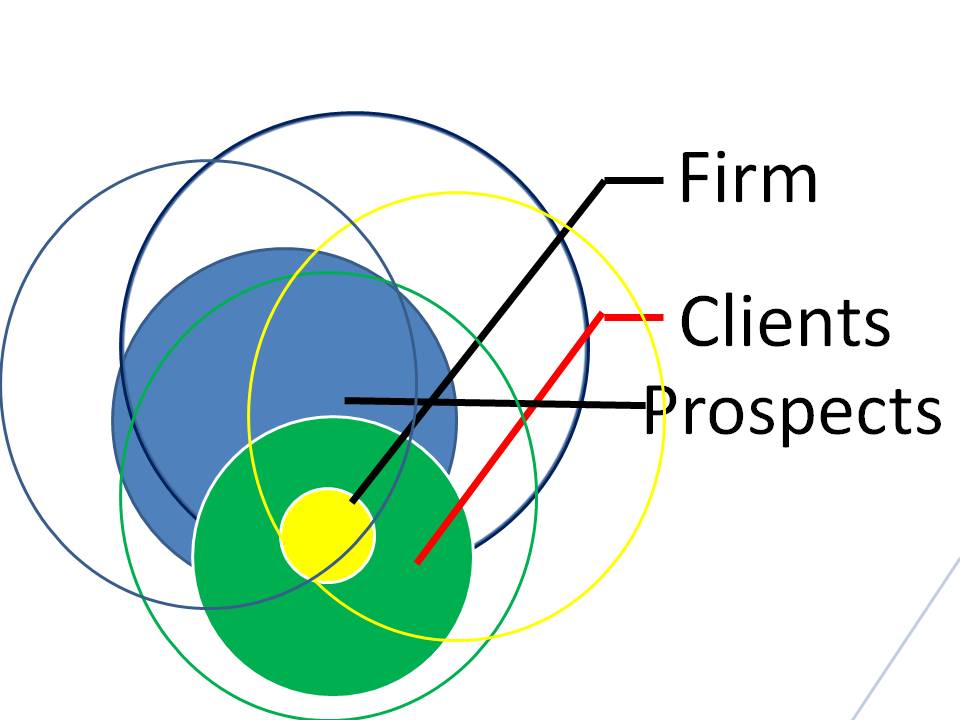
In other words, you have to create something that draws clients and prospects to you.  The illustration shows a relationship between your firm, the clients you serve and prospects you are trying to acquire. It also shows a series of different colored rings.  The rings represent the social media that is bombarding everyone.  Whether you are selective in choosing social platforms to participate in or take the shotgun approach, none of it will benefit until you become part of the conversation.

It can’t be like the conversation you have with a young child.  Every question is answered with a yes or no.  Your social media strategy has to be proactive.  It has to draw people to you.  Consider your website an electromagnet.  The electromagnet needs energy to work.  In order for your website to be more than an electronic Yellow Pages, your social media applications have to be energized.
Putting a regularly updated blog on your website is one way to energize your website.  Our 2013 seminar series will address the magnetizing of your firm in more detail, but this should get you started.

2. Cherish Existing Clients

Every firm has a pipeline, backlog, and existing client database when they begin the new year.  Too often these are treated simply as numbers in the marketing plan.  The planning is based upon reasonable assumptions that clients will have new work or additional services on existing contracts.  We have relationships with these clients and they might have appeared at our annual holiday party in December.  The question is, do we cherish them?  We can start by developing a better understanding of their business which will lead to offering assistance when a project is not the motivation.  How about interviewing existing clients and making it part of a video blog for your website? The interview doesn’t have to be about having the client pat you on the back for good service.  Focus on what this person has to say about his industry or her business.  If the client comments about the length of the relationship or trust, it pays double for your firm.  Finally, does your marketing plan get specific about what you will do for each client in the coming year?  When you think about your clients more than you think about yourself, the client relationship will strengthen and advocates will be born.

3. Acknowledge Your Competition

Does your 2013 Marketing Plan pay lip service to your competition?  Every firm knows the names of the competition, their principals and business development representatives.  But, how much intelligence do you really have about them? You might know the clients they have, but what about the relationship they have with those clients?  Do you know their expansion plans?  Is any of this important in your marketing plan?    Remember, these are the tips for you to reach the perfect marketing plan.

Vince Lombardi, the legenday coach of the Green Bay Packers, had this to say about perfection, “Perfection is not attainable, but if we chase perfection we can catch excellence.”  Therefore, work to get as much information as you can about your competition.  If for nothing else, they will be doing the same thing to you.
4.  Listen to the Marketplace


Marketing has always been more about broadcasting the brand, services, expertise, talent and projects than is has been about listening to what the market is looking for.  Obviously, this tip points you to research.  On one level this dovetails with tip 2, but it must be expanded to achieve perfection.  Allied industry associations are goldmines, if you are active in committees and boards.  Simply joining an association and attending monthly meetings will do little to move your marketing forward.  Since even a blind squirrel gets a nut every now and then, attending the monthly meeting can provide a lead or two as well.  These leads will be the same as what your competition is receiving.  When you listen to the marketplace you have the chance to become a change agent.  People like change agents.  People trust change agents.  Now is the time to put some listening into your marketing plan.


5. Don’t Forget the Basics

What have you learned from clients over the years?  Have prospects given you any surprises.  How about your presentation strategies and the elements of your teaming process?  Is 2013 the year of the status quo or a time to build for the future by tweaking the past?  These are three questions that need to be contemplated as you complete your 2012 marketing plan.  What are the basics?  Start with strengths, weaknesses, opportunities and threats (SWOT).  Bring your entire team into the discussion.  Everyone means administration to technicians.  When everyone has been asked to participate, it is amazing what you discover has been missing and what is not needed.
Hopefully, these tips have relevance for your firm.  Additional information can be obtained by contacting trystanderson@businessdevelopmentpros.org  or attending one of the 2013 seminars that will be scheduled in a city near you.

Monday, November 19, 2012

Business Development: CRM to Social Responsibility


"I've learned that people will forget what you said, people will forget what you did, but people will never forget how you made them feel” –Maya Angelou

Have you ever had to tell the staff that your best client just fired you?  How many great clients have you lost in the last five years?
What was the cause?  Sometimes it is neglect which on its face sounds like something no firm would ever commit.  Often, it is our reliance on technology to cover the marketplace with our marketing and business development activities.  Advances in CRM capabilities have given many firms a crutch and misperception that client relationships are solid. It is easy to track client activity and for management to keep track of business development resources.

Whether your contact management system is Deltek Vision,  Act or custom fields in Access, you have to remember the devil is in the details of business development.  In other words, turning data into new business is only accomplished when yo ur actions use data to your advantage.  Remember, data is not an action word.  CRM is a great tool when professionals take the appropriate actions.
In the Business Development Professionals training and consulting activities we stress that contact management is one piece of the puzzle.  It may be the glue that brings the pieces together, but glue by itself is only a sticky mess.  We stress that firms need to be diligent in assembling as much data as possible. 

Analyzing your data is only one step.  In order to complete a $100,000 sale, you need a $100,000 relationship.  The key word in CRM is relationship.  In a digital world where we are bombarded each day with thousands of messages, data helps us keep focus on the important client issues that will move opportunities forward.  Relationships are personal, with each client requiring a different approach.  Obviously, the size of the expected contract has something to do with the requirements for strengthening the relationship.  When we drill down to building relationships will all of the key decision makers, the process gets more complicated.  Data is needed on multiple people, vendors, competitors, industry changes, government regulations, the economy  and historical data on the client.  If we are bombarded with messages, we must remember that our clients are experiencing more.
The larger the potential fee, the greater the need for building a Platinum relationship.  Your business development and marketing professionals need to be client advisors.  Every one of your competitors can provide solutions to your client’s problem.  The $60,000 question for most firms is how to become a trusted advisor.  Rainmakers and principals of most firms have selected clients where they are viewed as trusted advisors.  However, times are changing.  The management at companies has changed over the last 10 years.  Are you still the trusted advisor for all of your clients?

Clients leave firms for many reasons.  There are many reasons why your firm is successful in acquiring clients.  The reasons are not exclusively economic.  In our training programs we have attendees analyze both the influence their decision maker has in the selection as well as their personal needs.  Why is this important?  It is not always about the money.
There are many sites on social networks where industry professionals are asking questions about business development and marketing practices.  Some come from seasoned professionals, but most are from people just starting out in the industry.  What is the key piece of advice that both groups can be offered?  What is the common thread that runs through all of the questions?  The key question being asked is about strengthening client relationships.  They don’t ask about the number of times a client should be entertained or whether it is important to know personal details such as birthdays and anniversaries. 

Mayo Angelou had it right when she said, "I've learned that people will forget what you said, people will forget what you did, but people will never forget how you made them feel”  You become a trusted advisor because the clients remembers how you made them feel.  Were you with them when there wasn’t a project?  Did you provide business advice when they were at a crossroad?  Did you ever ask them, “How can we help you?” 
Social responsibility is a new buzz word in our culture today.  It is an age-old practice of people helping people.  When Jesus told his Disciples the story of the Good Samaritan, it was about social responsibility. The firms that benefit and are successful being socially responsible do not do it for the photo op or an article in the company newsletter.  They see their values reflected in the good they do for others.

This could mean swinging a hammer alongside a client while building a home for Habitat for Humanity. It could be joining a client on a walk to fight breast cancer as one of his employees is fighting the disease.  You might have heard the saying, “You will find your treasure where your heart is.”
The mission and values of your company go beyond making profits, solving client problems and providing opportunities to employees.  They are also the final ingredient of a successful marketing and business development program.  Technology, the economy and culture do not change these.  Sometimes we just need to be reminded that at the core of our business, we are a group of people helping another group of people achieve their dreams.  In our industry, it just happens to be something built with brick and mortar.